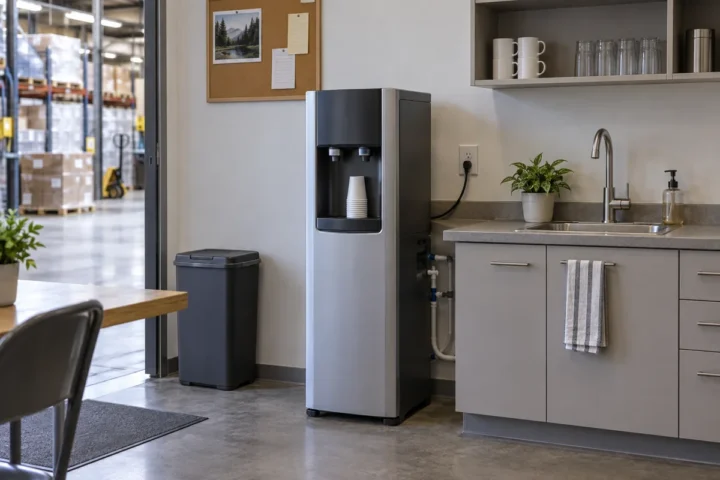
Filtration labels are easy to oversimplify. Activated carbon, sediment filtration, reverse osmosis and ultraviolet treatment perform different jobs. More stages do not automatically mean better water, and no treatment train should be selected only because a brochure uses the word “purified.” A useful office water plan begins with the source water, the concern being addressed and the maintenance required to keep the system working as intended.
Buyers should ask for the proposed filter configuration, performance basis and replacement schedule in plain language. The provider should be able to explain why each stage is present. For the broad purchasing framework, use the office water service guide and the separate water delivery pricing guide.
What the common treatment stages do
Sediment filtration protects downstream components
A sediment cartridge can reduce particles such as rust or suspended material above its rating. It does not solve dissolved-mineral, taste or microbial concerns by itself.
Activated carbon addresses specific taste and chemical concerns
Carbon is commonly used to reduce chlorine-related taste and odor and certain compounds, depending on the media and certification. Capacity and contact time matter; an overdue cartridge cannot be assumed to perform like a new one.
Reverse osmosis reduces many dissolved substances
RO forces water through a membrane and typically produces a concentrate stream. Pressure, water quality, storage and sanitation affect performance. It may be unnecessary where the goal is only chlorine taste reduction.
UV is a treatment component, not a universal filter
Properly designed UV can inactivate susceptible microorganisms, but it does not remove sediment or dissolved chemicals. Water clarity, lamp condition and exposure determine effectiveness.
Match treatment to a defined concern
- Taste and odor: A properly selected carbon system may be appropriate when the source is otherwise suitable.
- Dissolved solids or specific contaminants: RO or other targeted treatment may be considered after reviewing actual water information.
- Microbiological risk: Source-water safety and qualified treatment design require more than adding a UV label.
- Scale management: Hardness and scale can require pretreatment or a maintenance plan to protect hot tanks and valves.
A practical planning checklist
- Identify whether the source is municipal water, a private well or another supply.
- Review available water-quality information and the specific concern being addressed.
- Request component certifications or performance documentation relevant to that concern.
- Confirm cartridge, membrane, lamp and sanitation schedules.
- Ask how technicians record completed service and how users report taste or performance changes.
A common office request is “reverse osmosis because it is the best.” Sometimes RO is appropriate; sometimes a simpler carbon system meets the taste goal with less water waste and maintenance. The right answer comes from the water and the objective, not the number of stages.
Questions to ask before signing a service agreement
- What does each proposed stage reduce?
- Which performance standard supports that claim?
- How is filter life determined?
- Who sanitizes the reservoir and dispense path?
- Does the system create a concentrate stream?
- How are service dates documented?
A useful proposal should state the equipment, installation work, filter or bottle schedule, preventive service, response process, term, price changes and end-of-agreement responsibilities. Compare each provider against the same written scope. That is more reliable than comparing a promotional monthly number with an incomplete list of inclusions.
Frequently asked questions
Does reverse osmosis remove everything?
No treatment removes every substance under every condition. Review the membrane specification, system design, source water and maintenance.
Is UV-treated water sterile?
No responsible office-water claim should assume sterility. UV performance depends on design, water clarity, lamp output and exposure, and it does not remove chemical contaminants.
How often should office water filters be changed?
Follow the equipment and filter requirements plus actual water conditions and usage. Calendar intervals alone may be too long or unnecessarily short without considering capacity.
The next step
Define the taste, quality or operational concern first, then ask for a treatment design that directly addresses it with verifiable maintenance. When the requirements are clear, compare office water service prices using the same facts for every option. You can also browse the office water FAQ center for focused answers about installation, filtration and ongoing service.